


Europe dominates global wealth rankings, but what it actually means to be a “rich country” depends largely on how prosperity is measured and who benefits from it.
“Being the richest country in the world is not just about producing a lot,” says an analysis by financial services comparison platform HelloSafe, reports Buz Post.
“It is measured by how this wealth translates concretely into the everyday lives of the average citizen. In 2026, the answer is Norway,” HelloSafe said.
The group argues that GDP per capita alone can distort comparisons, as it assumes that national output is shared equally across the population.
Ireland illustrates the point. GDP per capita is around $150,000 in purchasing power parity terms, but much of this is driven by multinationals such as Apple, Google and Pfizer.
The gap between output and household income is estimated at around $70,000 per person.
Addressing these limitations, HelloSafe’s “Prosperity Index” ranks more than 50 countries using a combined score out of 100.
It draws on data from the IMF, World Bank, UNDP, Eurostat and OECD, combining income, inequality and broader social indicators into a single measure of prosperity.
On this basis, Europe dominates the top of the rankings, with the five richest countries all located in the region.
Small countries leap ahead
Norway tops the table, supported by the world’s highest GNI (Gross National Income, the total income earned by a country’s people and businesses, including income earned abroad) and a very balanced social model.
Ireland is second, with high real incomes despite an inflated GDP figure. Luxembourg is third, falling from first place for the first time since the index began.
These countries combine strong economic performance with some of the best social indicators globally, according to the report.
Other top performers include Iceland, which ranks fifth, supported by strong human development indicators and low levels of relative poverty.
Singapore, by contrast, ranks 17th in income but is hampered by higher inequality.
Outside Europe, the United States ranks 17th, reflecting economic strength coupled with high inequality and relative poverty.
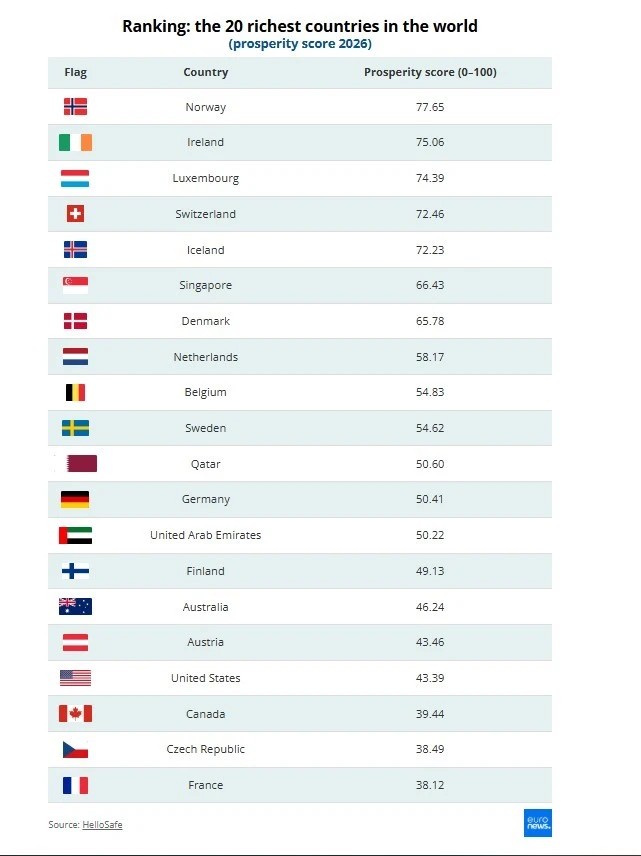
France ranks 20th, just behind the Czech Republic, which benefits from one of the most equal income distributions in Europe and a low rate of relative poverty.
At the lower end of the European table, countries such as Italy, Spain and Estonia rank more modestly, reflecting lower income levels and, in the case of Spain, higher relative poverty.
Beyond Europe, Seychelles ranks first in Africa, driven by the continent’s highest GDP per capita, strong human development results and relatively low inequality. Mauritius and Algeria follow closely behind.
In Latin America, Uruguay tops the rankings for the first time, with the region’s highest GDP, lowest poverty and most equal income distribution. Chile and Panama follow.
In Asia, Singapore leads, followed by Qatar and the United Arab Emirates.
The results suggest that while Europe continues to dominate measures of global prosperity, the picture changes significantly once inequality and social outcomes are taken into account.
The data suggest that what it means to be “rich” is no longer defined solely by output, but by how widely that wealth is shared./BuzPost/